Exportable Records.
Clear Handoff Paths.
Scientific data should stay portable and reviewable. TARE is being built around exportable records, evidence references, and open handoff paths instead of trapping operational history in one interface.
Standard JSON Export
Your inventory, experiments, and sample data are structured. Your export should be too. We provide structured JSON exports that preserve supported record relationships.
No Punitive Export Gate
Supported export paths are available through settings and APIs for scoped records; broad workspace exports are confirmed during onboarding.
Portable Schema
Supported exports use documented JSON shapes that can be mapped into internal databases or migration pipelines.
How it works
Supported exports are generated through authenticated API routes and streamed where appropriate so larger record sets can be handled without turning export into a manual support task.
- Authenticated export API routes
- Streamed responses where supported
- Tenant-scoped record identifiers
{
  "metadata": {
    "system": "TARE",
    "exportedAt": "2024-03-21T10:00:00Z"
  },
  "organization": {
    "name": "Acme Labs",
    "id": "org_..."
  },
  "inventory": [
    {
      "name": "Acetone",
      "cas": "67-64-1",
      "quantity": 500,
      "unit": "ml"
    }
  ],
  "experiments": [...]
}
Reviewable Provenance
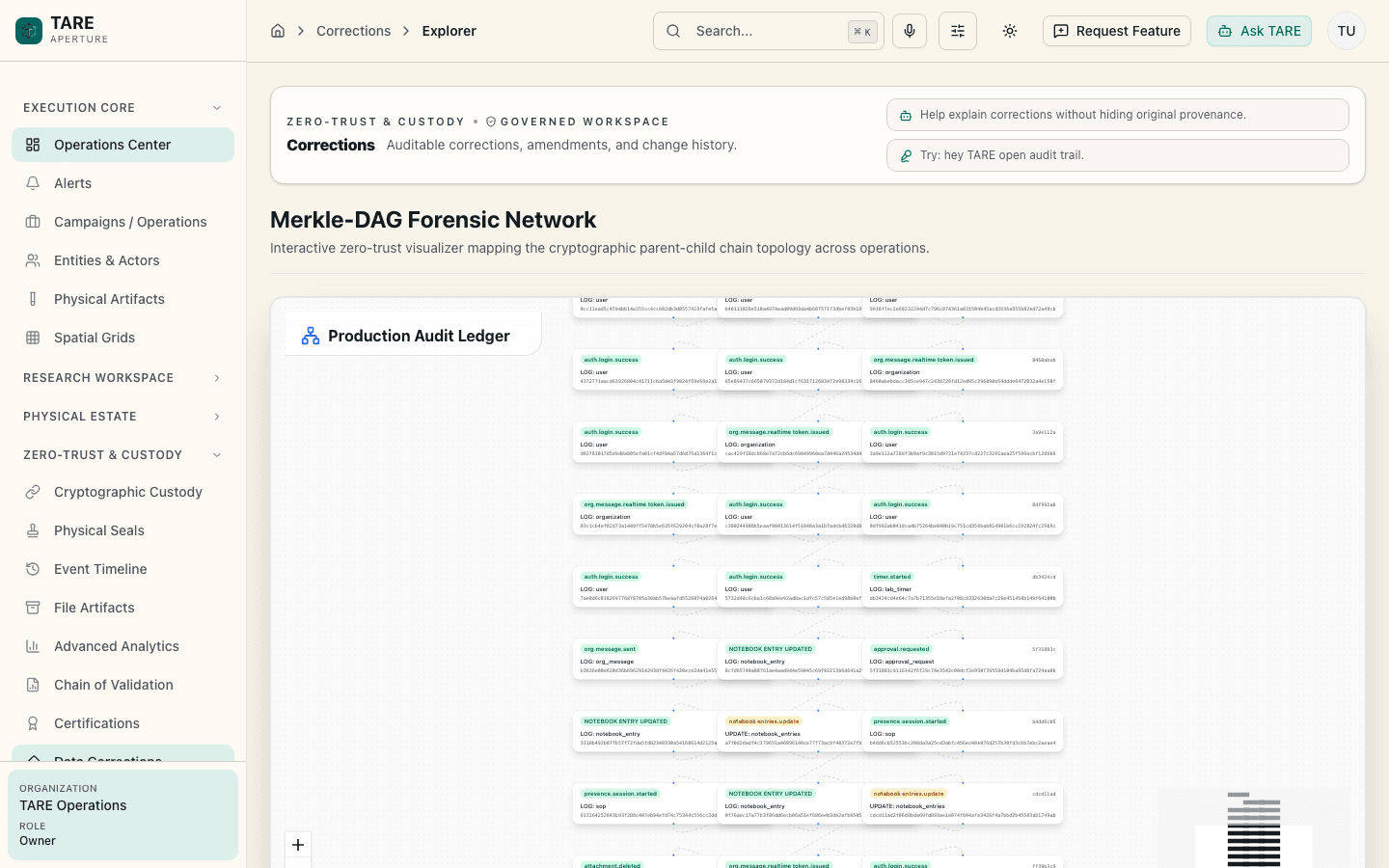
TARE links records, samples, materials, attachments, custody events, and exports into a reviewable history. Hashes and signed bundles help support integrity review, but formal provenance claims still depend on the scoped workflow and validation context.
Hash-Linked Audit Context
Supported record events can include canonical SHA-256 payloadDigest values. Changing represented data should produce a different digest and break verification for linked export context.
Multi-Parent Lineage References
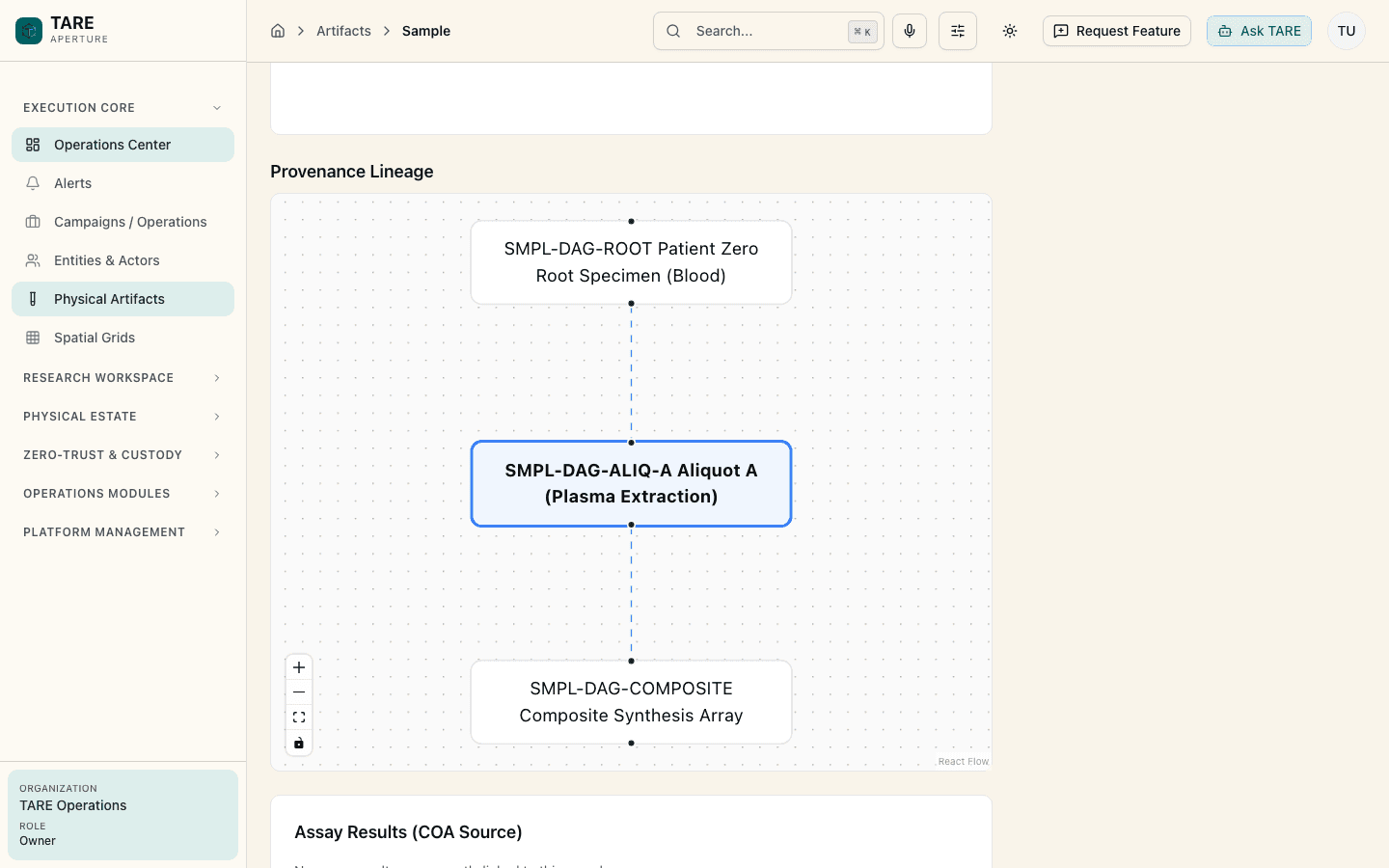
Real science is not always linear. When workflows combine multiple inputs, TARE records parent references such as parentHashes: text[ ] so reviewers can follow the represented lineage in the export context.