
Custody-aware lab records for evidence-sensitive teams.
TARE connects experiments, samples, materials, evidence attachments, custody events, model-assisted draft context, review decisions, audit history, and signed exports in one defensible record so your team can reconstruct what happened without chasing notebooks, spreadsheets, and shared drives.
Built for teams that need human-reviewed documentation support, defensible sample history, and exportable records.
Problem
Lab history falls apart when the record lives in too many places.
TARE gives evidence-sensitive teams one connected record across lab notes, samples, materials, attachments, review decisions, custody history, audit trails, and exports. It helps scientists, QA teams, and operators reconstruct what happened without stitching together notebooks, spreadsheets, shared drives, and email.
Product answer
One connected record for custody, review, and export.
TARE connects experiments, samples, materials, evidence attachments, custody events, model-assisted draft context, review decisions, audit history, and signed exports in one defensible record.
Document
Track
Review
Export
Core workflow
From activity to defensible export.
The workflow is intentionally conservative: capture context, connect the record, keep suggested content provisional, review the decision, and export what a reviewer needs.
Create the record
Open an experiment, sample, case, or material record with operator and workspace context.
Link the lab context
Tie notes to samples, materials, inventory, cases, protocols, locations, and custody-relevant events.
Review the assistance
Use model-assisted draft context as provisional support only; someone must review and approve before official record entry.
Export the evidence
Assemble audit trail, review decisions, custody events, attachments, hashes, and signed export context.
Why custody-aware records matter
Reviewers need to reconstruct what happened.
Cryptographic hashes can help detect tampering in canonicalized records and linked history. They do not prove scientific truth, workflow completeness, or compliance by themselves.
Compared with spreadsheets
Compared with paper notebooks
Compared with shared drives
Compared with generic ELNs
Compared with enterprise LIMS
Compared with generic note tools
Available now vs R&D
Clear maturity, no hidden product promises.
Design partner access focuses on ELN records, lightweight LIMS context, inventory and materials, sample and custody events, evidence attachments, audit trail primitives, and signed exports. Vision-assisted documentation, instrument ingestion, edge workflows, and hardware-adjacent automation remain active R&D unless scoped in a specific design-partner pilot.
| Capability | Status | Notes | Risk / limitation |
|---|---|---|---|
| ELN records | Design Partner Access | Experiment/session records, structured notes, attachments, review state, audit history, and signed exports. | Customer SOPs and validation determine regulated use. |
| Sample and material tracking | Design Partner Access | Lightweight LIMS context for samples, materials, inventory, locations, cases, and custody-relevant events. | Not a full enterprise LIMS replacement for every instrument or jurisdiction. |
| Evidence attachments and signed exports | Design Partner Access | Evidence files, hash context, audit trail, review history, custody events, and export packaging. | Hashing detects changes in represented data; it does not prove scientific truth or compliance alone. |
| Documentation Support | Active R&D | Drafting, organization, missing-context checks, and review support with human approval. | Suggested content remains provisional until reviewed by a human operator. |
| Vision-assisted documentation | Active R&D | Image/video-assisted observation drafting and evidence organization. | Not a safety-authoritative or validation-authoritative workflow. |
Human-Reviewed Documentation
Drafting can help organize the record. People approve the record.
Model-assisted drafting can organize selected context, but suggested content stays provisional until an accountable reviewer approves it into the official record.
Review model data processingGHS label generator
Start with a free label tool, then connect labels to controlled records.
The public GHS label generator helps teams draft and print reviewed labels. TARE can connect those labels to inventory, SDS context, materials, and evidence-sensitive records when a controlled workflow is needed.
Try free GHS label generatorLookup
CAS/name assisted hazard draft.
Review
Required fields checked before queue.
PDF export for label sheets.
Trust, security, compliance support
Give security and QA reviewers concrete artifacts.
TARE is designed to support controls relevant to electronic records, audit trails, electronic signatures, review workflows, and ISO/IEC 17025-style evidence expectations. Final validation depends on the customer workflow, SOPs, configuration, and regulated use case.
Request security packetTarget use cases
Built for evidence-sensitive lab workflows.
TARE is for small to mid-sized evidence-sensitive labs that need better records, custody, review, and exportability without a heavyweight enterprise LIMS implementation.
Explore use casesForensic / Evidence
Pain: Custody, audit trail, evidence, signatures, and defensible exports must stay connected.
Supports today: Case-aware records, evidence attachments, custody-relevant events, hashing, audit trails, and signed exports.
Not yet productized: Full agency-specific validation packets and every forensic lab instrument workflow.
Environmental / Water
Pain: Field collection, sample history, attachments, and reporting context often split across tools.
Supports today: Sample and material context, field evidence attachments, reviewable records, and export bundles.
Not yet productized: Complete regulatory reporting templates for every jurisdiction.
Materials / Industrial Testing
Pain: Specimens, test records, photos, instruments, operators, and attachments need durable linkage.
Supports today: Experiment records, sample/specimen context, media attachments, audit trails, and review workflows.
Not yet productized: Deep instrument ingestion and calibration packages for every test method.
R&D Lab Records
Pain: ELN work, protocols, observations, reagents, assistant output, and review state drift apart.
Supports today: ELN records, protocol-aware notes, inventory/material context, and human-reviewed documentation support.
Not yet productized: Validated protocol generation or hands-off lab execution.
Chemical Inventory / GHS
Pain: Labels, SDS context, materials, storage, and records often live outside the controlled workflow.
Supports today: Free GHS label generation, inventory/material context, label review, and record linkage paths.
Not yet productized: A universal EHS replacement or regulatory review substitute.
Pricing and pilot path
Start with one real workflow.
Walk through records, samples/materials, evidence attachments, model-assisted documentation, review gates, and export requirements. We will tell you whether TARE is a fit, what is available today, and what requires design-partner scoping.
Design Partner
Regulated Workflow Pilot
Enterprise / Security Review
Product surfaces
Real product screens, not a concept page.
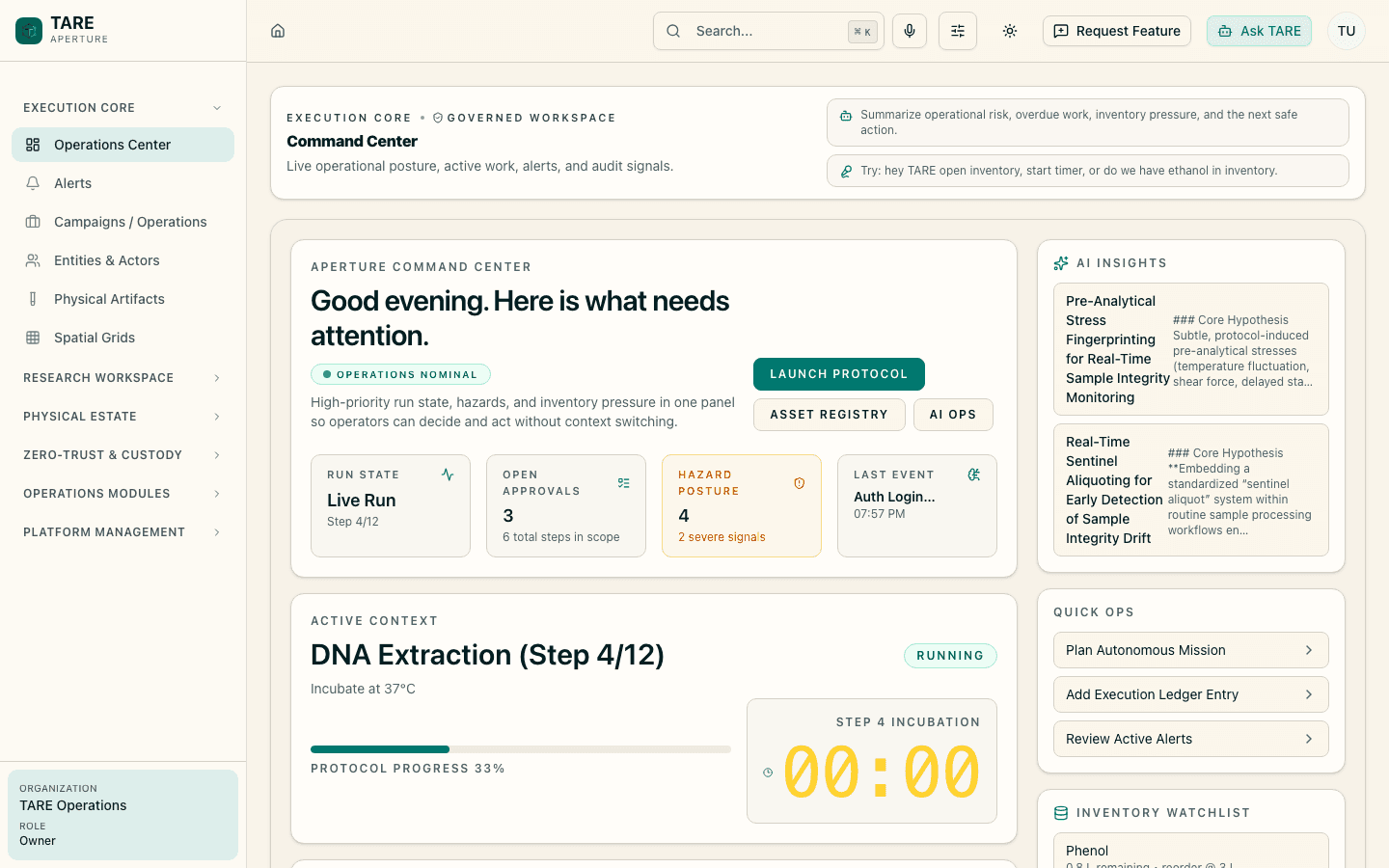
TARE is being shaped around real lab screens for records, samples, inventory, plates, metrology, custody, evidence, and review queues.
Command workspace
A dashboard-level view of lab records, operational status, and review queues.
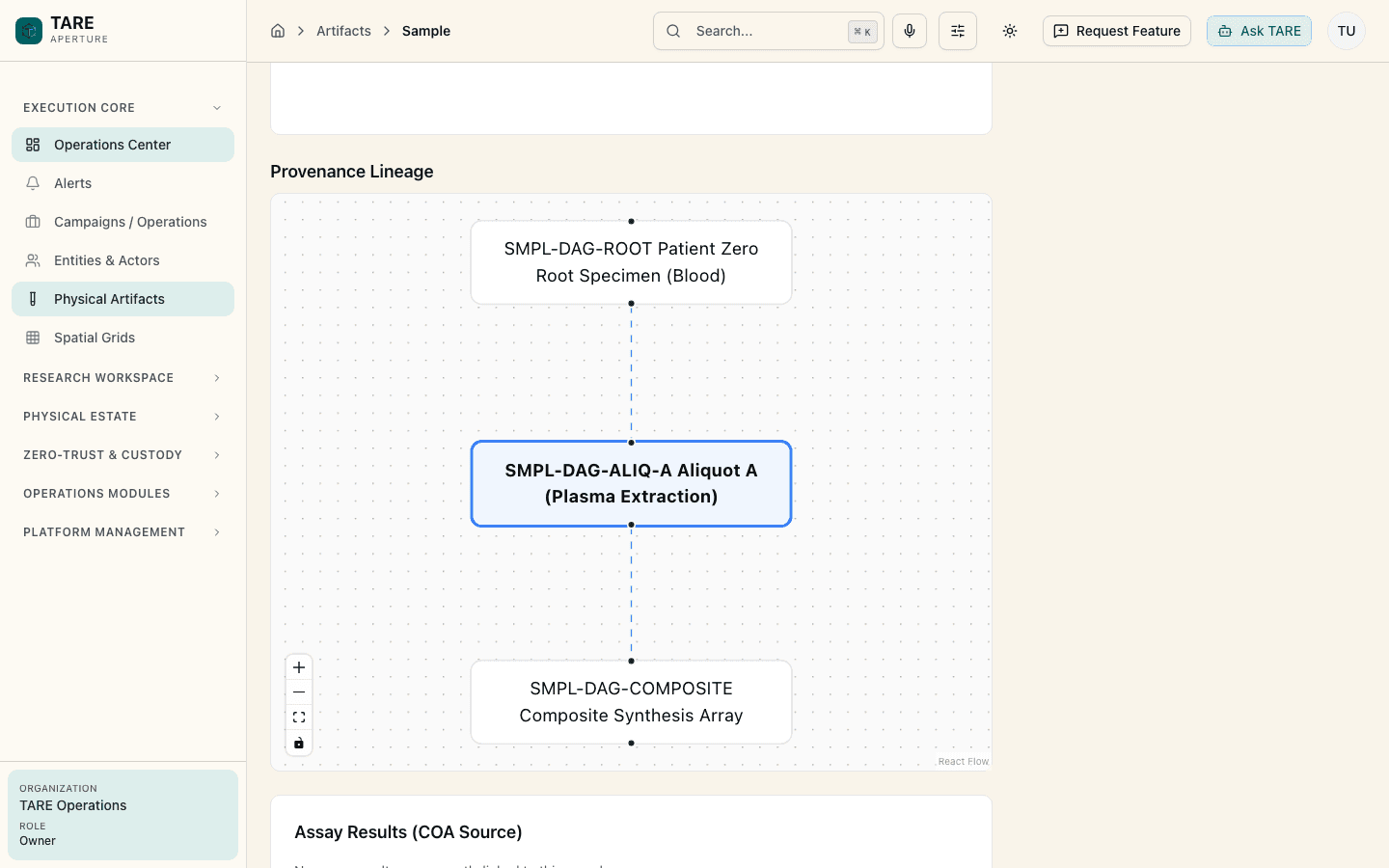
Sample and lineage context
A provenance-oriented view for sample relationships, evidence context, and history.
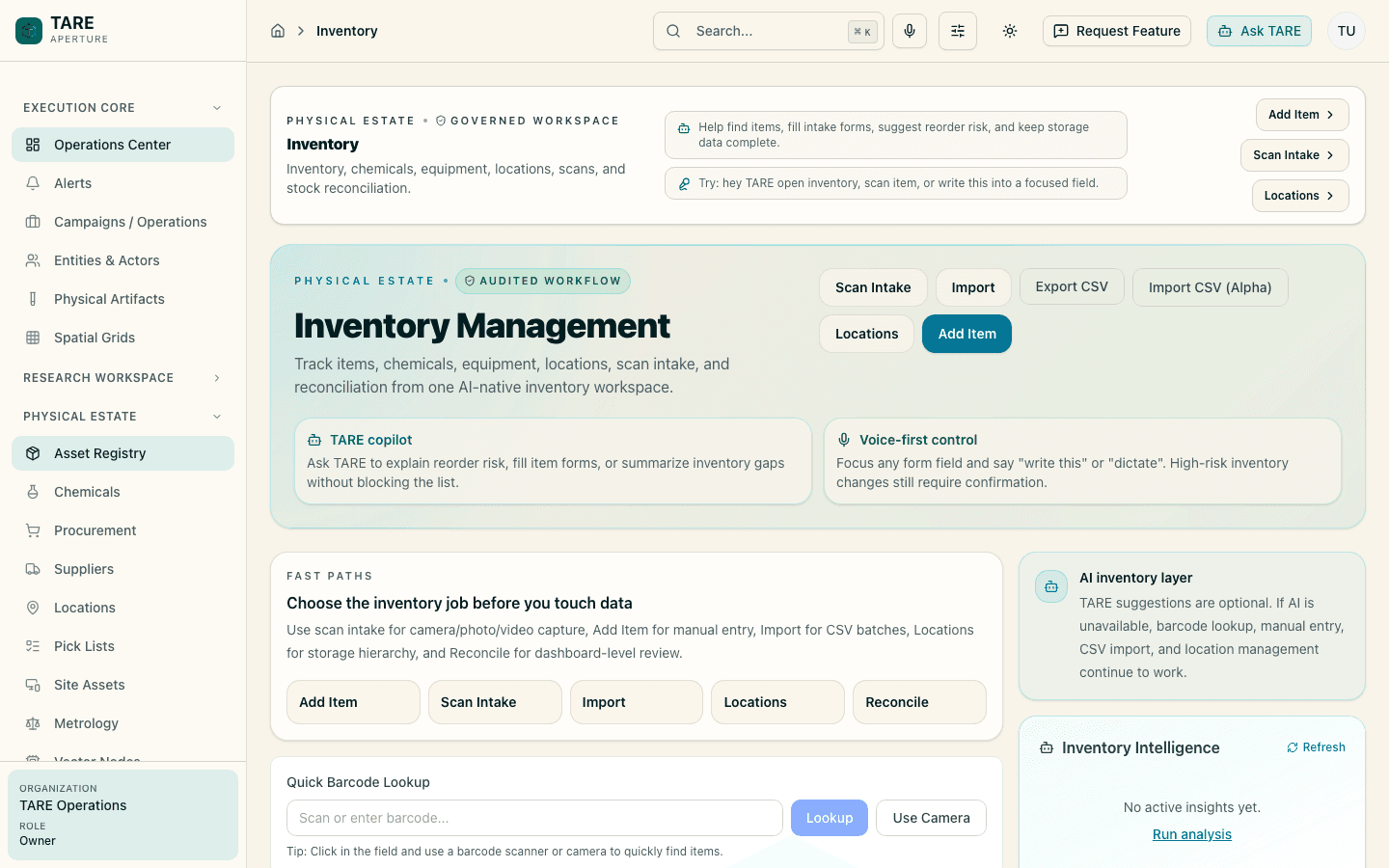
Inventory and materials
Structured inventory views for materials, locations, hazards, and lab operations.
Bring one evidence-sensitive workflow. We will map the record.
A workflow review is a practical fit check across records, samples, evidence, review gates, documentation help, security expectations, and exports.