Reviewable Provenance: How TARE Uses Merkle-DAGs for Chain of Custody
In evidence-sensitive laboratory environments, whether handling controlled substances, infectious agents, or critical forensic evidence, Chain of Custody (CoC) is a practical requirement for reviewable records.
For decades, Laboratory Information Management Systems (LIMS) have relied on standard relational databases (SQL join tables) to track where a sample came from. Relational tracking can still work, but it needs strong audit history, access control, and verification context to support retrospective review.
The TARE Approach: Hash-Linked Provenance Context
TARE represents important record events with hash-linked context. Instead of treating files and observations as detached notes, TARE connects inventory movements, sample references, and instrument observations into a reviewable history.
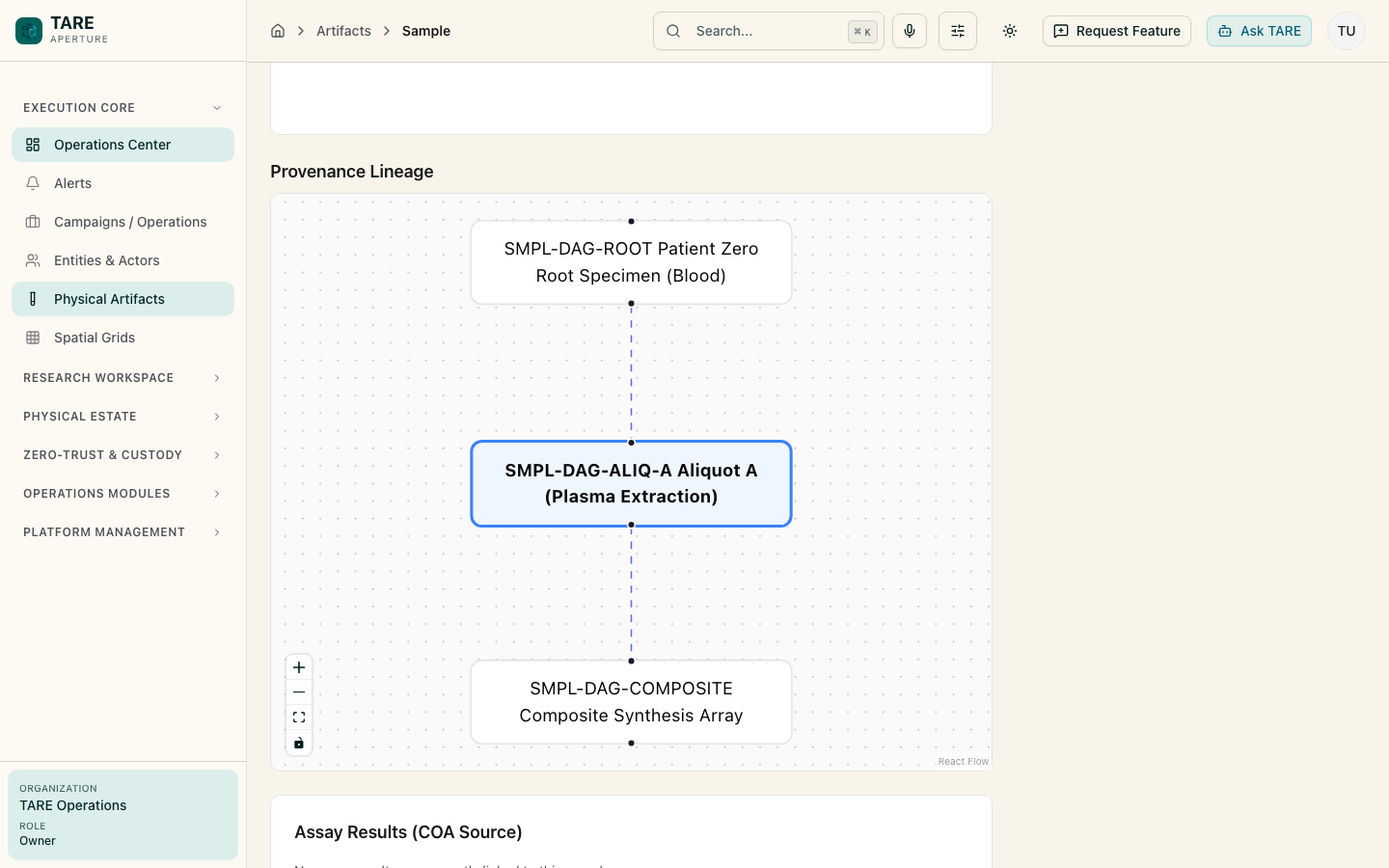
Supported record events can include canonical SHA-256 digests. When a derived sample is created, the new record can reference parent identifiers and related digest context so reviewers can compare the represented lineage later.
Universal UUID Namespace
TARE uses uuid identifiers for core entities such as users, physical inventory locations, scientific assets, and sample tubes. Stable identifiers reduce collision risk and make it easier to connect edge-generated records back to the reviewed workflow context.
Multi-Parent Convergence
Real science is not always linear. High-throughput labs may pool aliquots from multiple source tubes. TARE can record parent references such as parentHashes: text[] so the represented lineage stays visible during review.
Why It Matters
By hashing the payload alongside ancestor references, TARE can preserve a resilient web of evidence. If represented historical data changes, downstream verification checks can help surface the inconsistency.
The result is a record model where cryptographic hashes can help detect tampering in canonicalized records and linked history. Cryptography supports review, but it does not prove scientific truth, workflow completeness, or compliance by itself.